Crane overload incidents on Indian construction sites rarely happen because a crane lacked capacity. They happen because real-time load behaviour was misunderstood, ignored, or inaccurately measured.
Across high-rise and dense urban construction projects, especially where tower cranes operate in restricted zones, safe load indicators for cranes are now standard equipment on paper. Yet overload-related failures continue to surface, even on sites that are technically compliant.
The problem is no longer awareness.
The problem is how crane load indicator systems are selected, calibrated, and actually used under real site conditions.
For EPC contractors, safety heads, and project planners, a Safe Load Indicator (SLI) is no longer just a safety device. It is a decision system that directly impacts crane uptime, audit outcomes, and site accountability.
This article examines where SLIs fail in real conditions, why those failures lead to risk, and how leading projects are improving crane safety through better load monitoring strategies.

Most overload events are not sudden failures. They develop gradually through:
On congested construction sites, these risks often overlap with poor lift planning and weak monitoring discipline, especially when crane planning and selection are not aligned with actual site conditions.
When a crane load indicator system does not reflect real site conditions, it stops acting as a safeguard and becomes background noise.
This is where many projects mistakenly believe they are “covered” simply because an SLI is installed.
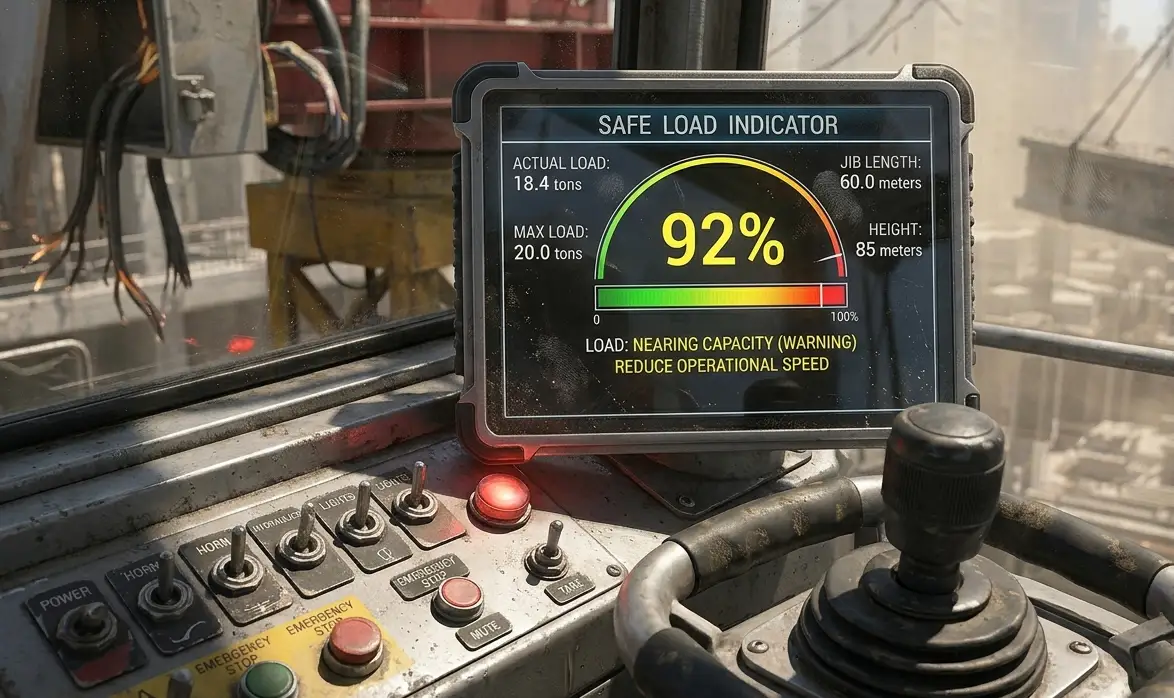
SLI calibration is often treated as a one-time commissioning task.
In reality, crane configurations change frequently:
If calibration is not updated accordingly, the safe load indicator may:
Many crane load indicator systems operate on default thresholds.
On site, this leads to:
When operators start ignoring alarms, the system becomes ineffective.
Overload risk rarely exists alone. It often overlaps with:
On modern construction sites, Safe Load Indicators and anti-collision devices are increasingly treated as a combined safety layer, not separate systems.
Projects integrating both through unified safety solutions typically achieve better control over complex lifting environments.
You can explore how integrated crane safety systems are implemented in practice here:
Anti-collision and Safe load indicator systems for cranes
Even experienced operators cannot accurately judge:
On many sites, SLIs are installed but operator training is minimal.
This creates a critical gap between available system data and actual operator decision-making on site.
A large portion of India’s crane fleet operates with retrofitted SLI systems.
Common mistakes include:
Effective retrofits follow structured steps:
This is similar to how EPC teams approach crane retrofit planning and lifecycle management across projects.
While not uniformly mandated across all crane categories, safe load indicators are increasingly expected in safety audits and project compliance reviews.
SLIs now influence:
A crane without reliable load monitoring is no longer seen as compliant, it is seen as a risk.
High-density construction environments introduce combined risks:
In these conditions, standalone SLI systems are insufficient.
Projects now evaluate crane safety as a system, not a device.
This includes:
This shift reflects how modern crane safety is being implemented across large EPC projects.

For EPC teams, selecting an SLI system should go beyond features.
Key factors to evaluate include:
Projects that treat SLI selection as a technical decision rather than procurement typically see:
Projects that implement and maintain accurate crane load indicator systems report:
The return is not just safety.
It is predictability, a critical factor in EPC timelines.
After installation, reconfiguration, and periodically during operations (typically every 6 months or as per site usage).
Yes, but effectiveness depends on correct system selection, sensor placement, and load validation.
Usually due to poor calibration or excessive false alerts leading to alarm fatigue.
No. It should be integrated with anti-collision systems for complete safety coverage.
Yes. Properly configured systems with calibration records significantly improve audit readiness.
Safe Load Indicators are no longer compliance checkboxes.
They are critical control systems that influence safety, uptime, and project performance.
Projects that treat SLIs as basic devices continue to face risk.
Projects that integrate them into a broader crane safety strategy achieve:
In modern construction environments, accurate load awareness is not optional, it is operational intelligence.
Evaluate integrated anti-collision and safe load indicator systems designed for real site conditions to improve safety, compliance, and operational control.